THE NABOU CHRONICLES

Monday, November 05, 2012

An Adventure into the Great Bear Rainforest (Part 1)

In the last week of September I had the opportunity to visit a rare corner of BC, the Great Bear Rainforest (GBR). Getting to Vancouver and attending the prep briefing went all as planned. The next morning we were supposed to leave very early through a chartered flight to Bella Bella where we would switch into a smaller amphibian plane (Goose) for transport to a lodge reachable only by air or waterways.


Due to heavy fog at destination our take off was repeatedly delayed until it was decided to change the plan and fly us to Terrace. From there we made our way by bus to Kitimat (about 1.5 hours) where  boats would be waiting for our group. The boats turned out to be two speedy launches with covered cabin and one open boat for the luggage.

The final leg of the travel started around 3:30 pm making for a long day of travel. Fortunately, the weather was reasonable (cold but no rain). The scenery was breathtakingly beautiful. In one spot I saw an area without any vegetation that looked odd. It turns out that's what a logged area looks like.


 We were also lucky to encounter two pods of Orca whales on the way to the lodge that made us forget the long day of travel. They are such majestic and graceful animals. It's not easy to capture the whales on a photo with a point-and-shoot camera on a wobbly boat, but I did see them come up and blow and dive again less than 20 yards away. The blow noise from a near distance sounds almost human (a giant swimmer coming up for breath).  I did capture one at the tail-end of diving (literally!).

We finally arrived at the lodge, which turned out to be quite a luxurious and interesting operation. Here is a view from the air (coming back from a helicopter exploration of the surroundings). The actual lodge is to the right. The building on the left houses all staff and personnel.


The lodge operates within the Gitga'at First Nation Reserve and hires at least one third of its personnel from the local community. I was very impressed with the level of knowledge and environmental commitment of all the lodge staff. I was told that their CEO speaks to staff every year about the Triple Bottom Line concept. To what extent that commitment went, I couldn't have guessed.

As I discovered later both buildings are actually on floating barges. I was told that the lodge was built on a retired Navy crane barge. At the end of the season (mid September usually) two tug boats tow the buildings, the docks, and all the rest to Prince Rupert Island, where the barges are maintained in sea worthy condition. Nothing is left on site. The barge has it on-board power generators, 3-stage drink water filtering system, and a gray water processing. You can see the barge carrying the lodge and some mooring cables on the right in the picture below.
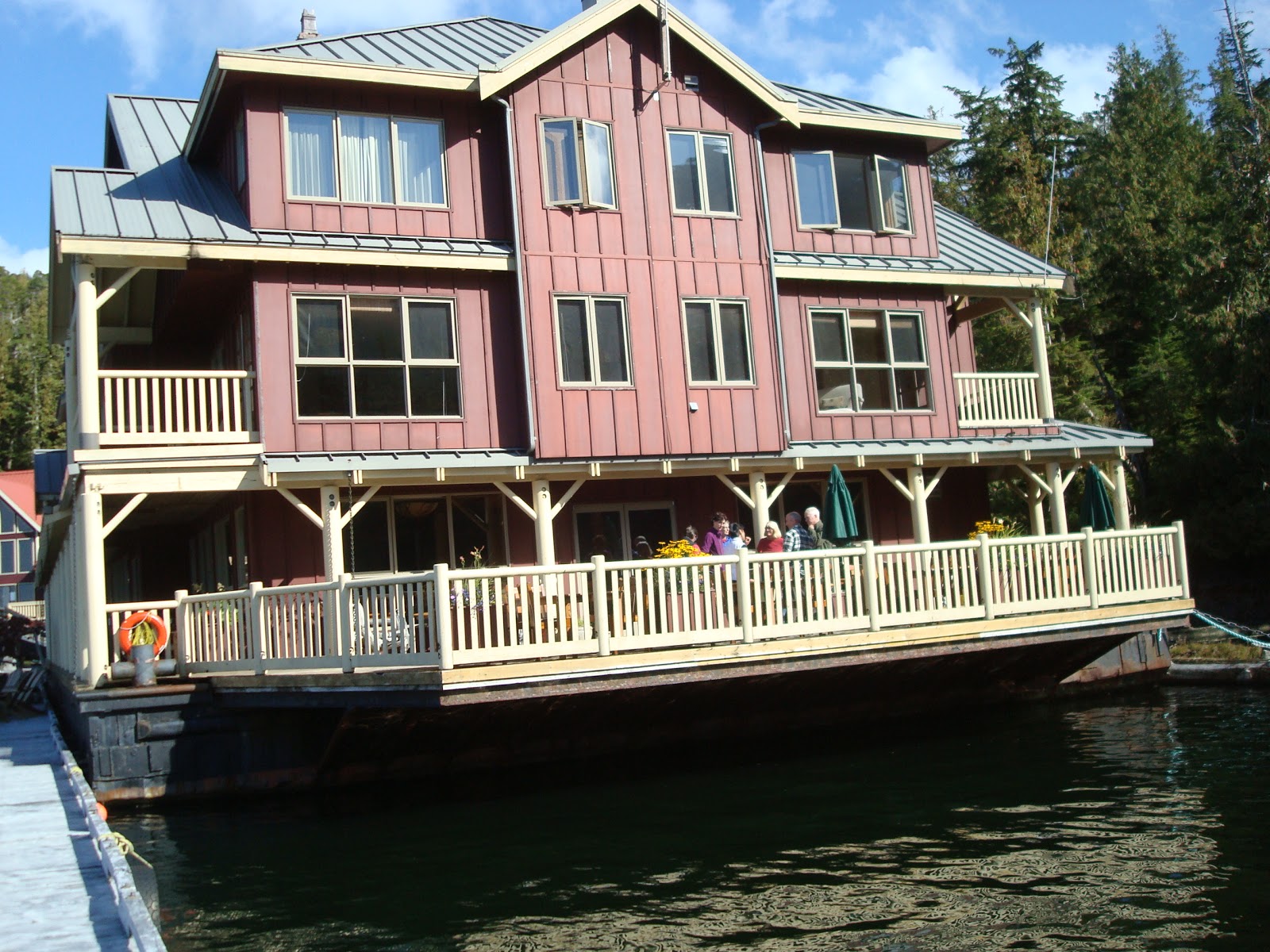
Click here for the official  King Pacific Lodge site.In the next installment of this blog, I'll be writing about my visit to Hartley Bay and Whale Point, two interesting and learning rich visits on the same trip.


Labels: , , , ,

Tuesday, November 16, 2010

We have no choice but to dare to be great

In September I had blogged about some of the stories told at BIF-6 and the random encounters of unusual suspects at the Collaborative Innovation Summit. In particular I wrote about Keith Yamashita's story and how it impacted me.

Since then I have reminded myself and others when we are planning or considering action, that we should dare to be great, and have found often that this simple sentence often ignites imagination and inspires the conversation to steer towards more ambitious goals and more significant change. The power of collectively imagining a "greater" future never ceases to amaze me and I am grateful to Keith for planting this seed in my mind.

Now the video recording of Keith's presentation at BIF-6 is available online. I highly recommend that you view it, and that you do so in a quite uninterrupted moment to enjoy the full power of his story.

Labels: , , ,

Sunday, October 24, 2010

New Ways for Citizen Engagement

Citizen initiatives are transforming the discourse, even the relationship between citizens and their governments. The most recent installment of evidence of this transformation came at this month's Unfinished Business Lecture at OCAD's Strategic Innovation Lab (sLab) on October 20, 2010.

SeeClickFix Platform

The invited speaker of this lecture was Ben Berkowitz, CEO of
SeeClickFix. I had the pleasure of attending Ben's presentation about the story behind his organization at the Collaborative Innovation Summit (BIF6) in September of this year and was happy that he could tell this story to a Toronto audience. Kudos to Michael Dila and his team at Torch Innovation for taking the initiative of inviting Ben to speak at the Unfinished Business Lecture that they sponsor. The series has been exceptional in the selection of topics and the quality of speakers.

Ben told the story of
SeeClickFix. It started as an initiative to fight unwanted graffiti in his neighborhood, morphed into a web application for reporting pot holes that needed repair, grew into a tool for alerting government officials to public works needed (pot holes and others), and blossomed into a global web 2.0 platform for citizen engagement and for citizen self-organized action.

Government Evolving

What I found interesting is that what started as an application to collect information locally about unwanted graffiti evolved rapidly not only as a platform for
the distributed collection of needed public works, but also as a tool for governments to cut their cost (roaming inspectors to identify needed repairs). Even when governments were short of resources to address the needs, they found open communications with citizen to provide transparency about the allocation of resources and to help dispel perception of preferential treatment of particular neighborhoods. The tactics of subscribing government officials to receive alerts generated within their jurisdiction without first asking for their permission, have increased pressure on officials to engage their citizens. Those who resist and resent the service provided by SeeClickFix are quickly identified by their citizens as non-transparent bureaucrats who are providing inadequate service. In return, the site's ability to display the status of reported issues (open, acknowledged, and closed) on a Google map is providing public works staff with a capability to publicly display their own work and performance.

Self-Organizing Citizens

Furthermore, citizen started using the platform not only for reporting issues but for peer-to-peer communications in order to organize their own actions addressing the issues reported. Examples ranged from a woman, who spray-painted the fading stripes of the pedestrian crossing on her street to Washington citizens posting what resources they can offer and organizing in small groups to help neighbors clear their driveways and sidewalks during the snow storms of the past winter. Some local governments are starting even to offer "civic points" for citizens reporting required works and organizing to help with addressing them.

Toronto's 311 Service

In the Q&A following the lecture, Peter Rose, a graduate student in OCAD's Strategic Foresight & Innovation program, asked Ben if Toronto, which has a 311 service, is using SeeClickFix. Ben mentioned having a phone conversation with someone in the Mayor's office. That person (Ryan) turned out to be among the audience. Peter then put Ryan on the spot asking him to provide the audience with an update on Toronto's government activities in that space. Ryan did not have detailed information (being away for 6 months and at the end of his term with the elections on October 25th), but he deferred to Dave Wallace, Chief Information Officer (CIO) of the city, who was also attending.

Sure enough, Dave came forward and provided an interesting insight into Metro Hall's plans and activities around open government and the open data movement.
One of the new applications of open data is Toronto's road closures information to help you plan your movement around the city.


What followed was a lively and informative conversation, typical of the Unfinished Business lectures. This and other open-data city activities will be the subject of another posting in the near future as I get more details, so stay tuned.


Labels: , , , , , , , , , ,

Tuesday, September 21, 2010

Random Collisions of Unusual Suspects

Last week I attended the Collaborative Innovation Summit in Providence, RI. Called BIF-6 in reference to it's organizer, the Business Innovation Factory and it's sixth occurrence, the two-day event exposes participants to thirty exceptional storytellers in a intimate theater setting. I had attended last year's BIF-5 and found it inspiring and energizing, so I went for more.

An even greater value in attending BIF-6 is really in the networking that takes place before, after and between the stories. BIF founder Saul Kaplan calls it "random collisions of unusual suspects" because he and his team use diversity and diversification as a core principle to enrich these collisions. Storytellers as well as participants are from every walk of life imaginable: from serial entrepreneurs, to educators, technologists, business executives, high-school students to a twelve-year old girl that set up a domestic grease collection and reprocessing into bio fuel that helped heat the house of needy families in her town.

Daring to be Great

The last presentation of Day 2 of BIF-6 was by Keith Yamashita, titled originally "Change, to the Power of Ten". Inspired and moved by previous storytellers and encounters with participants, he changed his title to "Is it worth daring to be great?" As he was reflecting on the role of trust between two people in the larger context of teams and organizations, he recounted an incident, when a business partner and mentor (Alan Webber) vested his full trust in him. For 10 seconds he became very emotional and a tear ran down his cheek. He quickly recovered and continued his presentation, but in those 10 seconds I learned about trust and its importance in personal relations and in social networks small and large more than any books or courses could teach.


Random Collision

Later the next day, in the coach taking us to Providence Airport I happened to sit next to another participant, Monika Hardy (@monk51295). With a long wait for our flights, we settled in one of the airport's seating areas, opened our laptops, intended to get some work done. But the conversation started in the coach did not want to go away. I was still reflecting on my learning experience from Keith's presentation, and found myself in an amazing deep-dive conversation with Monika, who turned out to be an innovator herself in the field of children education. I was fascinated and encouraged that in a public school system, a space has been allowed to experiment with new methods and ways. Monika described how children choose what they want to learn and are then guided by a different kind of teacher, a facilitator of learning that connects the dots of the child's interests without imposing an unnatural regiment of learning. In fact, the children go through a "detox" to unlearn some of the old behaviors learned in school.

Emotional Learning

As I was listening to her passionately describe her work , it occurred to me that the "detox" approach might well be applicable to business. We need to unlearn behaviors drilled into us by the existing system, before we can innovate new ways and structures to do business. I am planning on following up on this conversation.

So, what else did I learn? We seem to be wired for absorbing a significantly higher volume of knowledge, when we are emotionally engaged. Traditional learning, however, focuses primarily on information supply, without much of an emotional component. The result is that we learn the information without the full context that gives the information so much richer meanings in multiple dimensions. We do the same in business. As Keith said: "The biggest fallacy of business is that it's only rational. All business is personal and all business is human". That's why one random encounter with an unusual suspect can teach you more than volumes of HBR.

So as I am soaking up all the learning from these two random BIF-6 collisions, the question swirling in my head is: Could we design emotional components to our learning processes at every level? That's a very intriguing idea particularly as we witness the emergence of a new system of learning based on modules of knowledge that learners can pick and choose from. Imagine if each of these modules was designed to enlist an emotional component of learning.

I'll be trying to write about the many other encounters that sparked my brain at BIF-6, so stay tuned!

Labels: , , , , , , , , , , , , , ,

Tuesday, May 05, 2009

Single Sheet Creativity

A contest in Washington DC had only one condition: you are allowed to use a single sheet of white paper as your material. So how much creativity can be displayed around one sheet of white paper? Take a look at these amazing 26 pictures and judge for yourself what can be achieved with vision, knowledge and imagination!


Labels: , , , ,