THE NABOU CHRONICLES

Sunday, November 11, 2012

An Adventure into the Great Bear Rainforest (Part 2)

This trip into the Great Bear Rainforest (GBR) was rich in learning. It would be impossible to describe all the knowledge and experiences gained through it. Two experiences stand out in my mind and may help me illustrate.The first experience was the opportunity to observe wild life in the GBR environment. I had mentioned the many encounters with whales in my previous post. But this time we were on land in a stand overlooking a creek. We were fortunate enough to see a number of black bears hunting fish in preparation of their hibernation.[All photos courtesy of Mike Robbins].


One of the three black bears that we were able to observe was an older one, getting slow and less successful in catching fish. It fed on the leftovers of the other bears. It was not certain to survive the coming winter. Watching it was sad but reminded me of the immutable realities of life.

The ultimate experience was to be able to see the very rare Spirit Bear and to observe it for over half an hour relatively close. The Spirit bear was the most successful in catching fish. Apparently he has an advantage because of its white fur; fish don't get alarmed as much as with black bears. Another amazing fact I learned from our guide is that bears artificially constipate themselves ahead of hibernation by eating sand with the fish. In spring they then consume a specific plant that gets them normalized again. In the first photo below you can see the Spirit Bear looking for the fish hiding under a tree fallen into the creek .


In the second photo you can see the Spirit Bear finishing a large fish it caught a minute earlier.

Until very recently Gitga'at people were forbidden to speak about any sightings of Spirit Bears in order to protect them from hunters. But with support from Tides Canada the Gitga'at people have set up a watch program that has significantly reduced hunting and poaching in their territory, though not completely eliminated them.

The second experience that marked my memory of this trip was the visit to Whale Point. We landed on the southern tip of Gil island at a rugged rocky coast (no docks of any kind) and climbed a steep hillside of slippery black rocks. There we found two wooden buildings. A house in a small clearing and at the cliff overlooking the sea, a barrack. It turns out these are the home and workplace for Janie Wray and Hermann Meuter for the last 11 years! The house was built without cutting a single tree, using mostly drift wood, we were told. Power is generated through 2 banks of solar cells, one tree-top wind generator, and a run-of-the-river generator all charging a bank of 12 volt batteries. The batteries in turn feed a DC/AC inverter that provides 110V AC for the house and the barrack.


The barrack houses a lab (part of what Janie and Hermann call their Cetacea Lab) with electronic gear to listen and record whale signals from hydrophone (underwater microphones) placed at strategic points around Whale Point. Over the years Janie and Hermann have not only accumulated an extraordinary collection of recorded whales vocalizations but gained amazing insights into the whale songs construction. Janie told us about their observation of a whale adding a "sonnet" or segment to the pod's song, which then gets picked up by the rest of the pod. They also developed a number of catalogs for the different whales observed in the region.


 You can learn more about this amazing story of commitment at forwahles.org where you can read about Janie and Hermann work and even try to listen live to whale signals.

Labels: , , , , , , , , ,

Monday, November 05, 2012

An Adventure into the Great Bear Rainforest (Part 1)

In the last week of September I had the opportunity to visit a rare corner of BC, the Great Bear Rainforest (GBR). Getting to Vancouver and attending the prep briefing went all as planned. The next morning we were supposed to leave very early through a chartered flight to Bella Bella where we would switch into a smaller amphibian plane (Goose) for transport to a lodge reachable only by air or waterways.


Due to heavy fog at destination our take off was repeatedly delayed until it was decided to change the plan and fly us to Terrace. From there we made our way by bus to Kitimat (about 1.5 hours) where  boats would be waiting for our group. The boats turned out to be two speedy launches with covered cabin and one open boat for the luggage.

The final leg of the travel started around 3:30 pm making for a long day of travel. Fortunately, the weather was reasonable (cold but no rain). The scenery was breathtakingly beautiful. In one spot I saw an area without any vegetation that looked odd. It turns out that's what a logged area looks like.


 We were also lucky to encounter two pods of Orca whales on the way to the lodge that made us forget the long day of travel. They are such majestic and graceful animals. It's not easy to capture the whales on a photo with a point-and-shoot camera on a wobbly boat, but I did see them come up and blow and dive again less than 20 yards away. The blow noise from a near distance sounds almost human (a giant swimmer coming up for breath).  I did capture one at the tail-end of diving (literally!).

We finally arrived at the lodge, which turned out to be quite a luxurious and interesting operation. Here is a view from the air (coming back from a helicopter exploration of the surroundings). The actual lodge is to the right. The building on the left houses all staff and personnel.


The lodge operates within the Gitga'at First Nation Reserve and hires at least one third of its personnel from the local community. I was very impressed with the level of knowledge and environmental commitment of all the lodge staff. I was told that their CEO speaks to staff every year about the Triple Bottom Line concept. To what extent that commitment went, I couldn't have guessed.

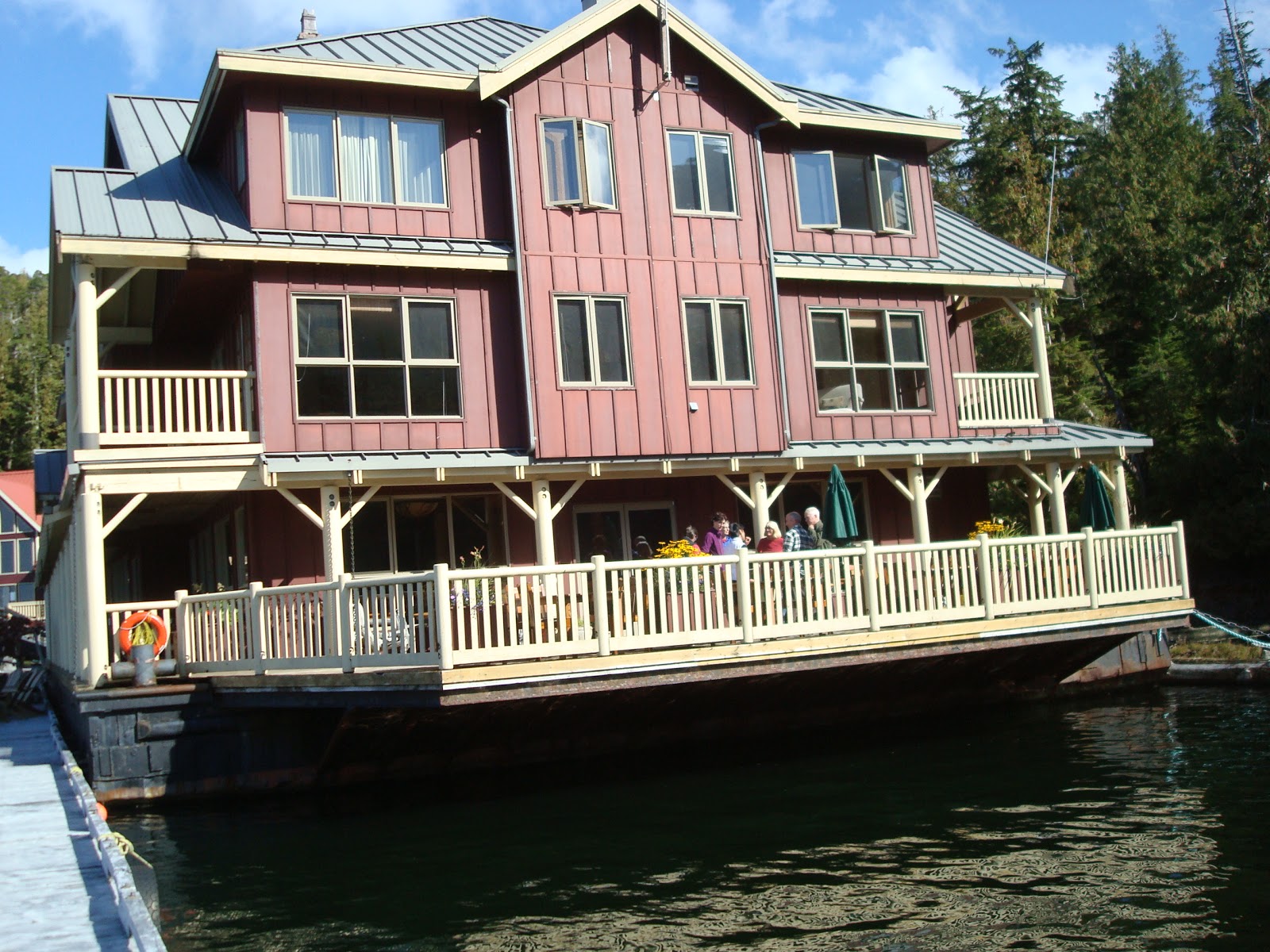
As I discovered later both buildings are actually on floating barges. I was told that the lodge was built on a retired Navy crane barge. At the end of the season (mid September usually) two tug boats tow the buildings, the docks, and all the rest to Prince Rupert Island, where the barges are maintained in sea worthy condition. Nothing is left on site. The barge has it on-board power generators, 3-stage drink water filtering system, and a gray water processing. You can see the barge carrying the lodge and some mooring cables on the right in the picture below.

Click here for the official  King Pacific Lodge site.In the next installment of this blog, I'll be writing about my visit to Hartley Bay and Whale Point, two interesting and learning rich visits on the same trip.


Labels: , , , ,

Tuesday, September 21, 2010

Random Collisions of Unusual Suspects

Last week I attended the Collaborative Innovation Summit in Providence, RI. Called BIF-6 in reference to it's organizer, the Business Innovation Factory and it's sixth occurrence, the two-day event exposes participants to thirty exceptional storytellers in a intimate theater setting. I had attended last year's BIF-5 and found it inspiring and energizing, so I went for more.

An even greater value in attending BIF-6 is really in the networking that takes place before, after and between the stories. BIF founder Saul Kaplan calls it "random collisions of unusual suspects" because he and his team use diversity and diversification as a core principle to enrich these collisions. Storytellers as well as participants are from every walk of life imaginable: from serial entrepreneurs, to educators, technologists, business executives, high-school students to a twelve-year old girl that set up a domestic grease collection and reprocessing into bio fuel that helped heat the house of needy families in her town.

Daring to be Great

The last presentation of Day 2 of BIF-6 was by Keith Yamashita, titled originally "Change, to the Power of Ten". Inspired and moved by previous storytellers and encounters with participants, he changed his title to "Is it worth daring to be great?" As he was reflecting on the role of trust between two people in the larger context of teams and organizations, he recounted an incident, when a business partner and mentor (Alan Webber) vested his full trust in him. For 10 seconds he became very emotional and a tear ran down his cheek. He quickly recovered and continued his presentation, but in those 10 seconds I learned about trust and its importance in personal relations and in social networks small and large more than any books or courses could teach.


Random Collision

Later the next day, in the coach taking us to Providence Airport I happened to sit next to another participant, Monika Hardy (@monk51295). With a long wait for our flights, we settled in one of the airport's seating areas, opened our laptops, intended to get some work done. But the conversation started in the coach did not want to go away. I was still reflecting on my learning experience from Keith's presentation, and found myself in an amazing deep-dive conversation with Monika, who turned out to be an innovator herself in the field of children education. I was fascinated and encouraged that in a public school system, a space has been allowed to experiment with new methods and ways. Monika described how children choose what they want to learn and are then guided by a different kind of teacher, a facilitator of learning that connects the dots of the child's interests without imposing an unnatural regiment of learning. In fact, the children go through a "detox" to unlearn some of the old behaviors learned in school.

Emotional Learning

As I was listening to her passionately describe her work , it occurred to me that the "detox" approach might well be applicable to business. We need to unlearn behaviors drilled into us by the existing system, before we can innovate new ways and structures to do business. I am planning on following up on this conversation.

So, what else did I learn? We seem to be wired for absorbing a significantly higher volume of knowledge, when we are emotionally engaged. Traditional learning, however, focuses primarily on information supply, without much of an emotional component. The result is that we learn the information without the full context that gives the information so much richer meanings in multiple dimensions. We do the same in business. As Keith said: "The biggest fallacy of business is that it's only rational. All business is personal and all business is human". That's why one random encounter with an unusual suspect can teach you more than volumes of HBR.

So as I am soaking up all the learning from these two random BIF-6 collisions, the question swirling in my head is: Could we design emotional components to our learning processes at every level? That's a very intriguing idea particularly as we witness the emergence of a new system of learning based on modules of knowledge that learners can pick and choose from. Imagine if each of these modules was designed to enlist an emotional component of learning.

I'll be trying to write about the many other encounters that sparked my brain at BIF-6, so stay tuned!

Labels: , , , , , , , , , , , , , ,

Saturday, August 07, 2010

Policy Innovation - What's the Urgency?

A few months back I had written a blog about the ups and downs of policy innovation. Since then may things have happened.

First, Change Camp 2010 has taken place and I was there as one of the on-line scribes that facilitated the 30 break-out groups of this remarkable event. It was an interesting experience that taught our team a lot about facilitating engagements at this scale (240 people).

Then I organized XCAMP, the unconference discussing the XCLINIC project. With the support of several peers from the Design with Dialog (DwD) practitioner group that meets monthly at OCAD's Strategic Innovation Lab (sLab) this smaller event was a great crowd-sourced co-design experience pushing the project a big step forward.

The most important time investment over the past few months (the one that took me away from blogging all this time) was put into developing a brand new graduate course "Business Model & Policy Innovation" and teaching the course to the first class of the MDes program in Strategic Foresight & Innovation (SFI) at OCAD. This has been an exhilarating and learning-rich experience, which we're about to wrap up with project presentations and critiques over the next 2 weeks.

Emerging Trends

During the course I hosted a number of guest lecturers including Toronto City Councilor Gordon Perks and Change Camp co-founder Mark Kuznicki. From the lively discussions throughout the course and the guest lectures, I came out with a renewed sense of urgency for policy innovation. Everywhere we looked (enterprises, government, academic institutions, NGOs) the trend swelling from the grass roots up was towards
more collaborative and participatory mode of working. And in most instances that trend was clashing with the vertical decision-making hierarchies and structures that characterize the 20th century.

Towards a Solution

I had highlighted the inherent risks of not addressing this gap in my previous blog about policy innovation. What has emerged through these various events is the beginning of a discourse about how to do so. In a conversation with Dr. David Wolf, Royal Bank Chair in Public and Economic Policy at the Munk Centre for International Studies, about how to address this gap, he envisaged governments shifting implementation efforts significantly towards grass-roots organizations and NGOs. Karl Schroeder, a Sci-Fi author, future scenarios writer, and graduate student at the SFI program suggested exploring a sequencing of these two different modes of organizing: horizontal networks and vertical hierarchies. Each of these modes excels at certain aspects and could be used at specific times in the process of policy making for example.

Mark Kuznicki provided real examples of how tremendous engagement and creativity by grass-roots initiatives in Toronto got stifled due to infighting between vertical hierarchies in Ontario. Everybody agreed with Mark, that how we address this fundamental issue is the conversation all who seek positive change must engage in. This could easily become a cornerstone of research in strategic foresight and innovation.


Labels: , , , , , , , , , , , , , , , ,

Monday, December 07, 2009

Web 2.0 - Beyond the Hype

On December 3 the Ontario Chapter of the CIO Association of Canada hosted an event and social under the title "Web 2.0, Collaboration, and Social Media: Beyond the Hype". The event was aimed to be an intimate gathering of peers (attendance was limited to 25) listening to practitioners and discussing the subject among themselves away from vendor and media hype.

I was invited by Samantha Liscio, CIO of Government of Ontario's CAC to participate in a speaker panel she organized and tasked with framing the subject and providing the basis for the conversation. My colleagues on the panel were: Kyle Reid, CEO of Deep Caliber; Bobby Singh, Director of Information Security at eHealth Ontario and John Sutherland, President of Ennova Inc. The panel was facilitated by Craig Ballance, Director of the IT Leadership Program at Ryerson University.

Discussion topics included:

  • How Web 2.0 and social media tools have successfully delivered on business goals
  • Key lessons learned from real implementations (the reality behind the hype)
  • What some unanticipated outcomes of the implementation of Web 2.0 and social media have been (pitfalls to avoid)
  • Why it's important to CIO success (moving from 'hype' to 'value')
  • What constitutes success in the practical application of Web 2.0, Collaboration and Social Media
  • What to watch for in the next waves of implementation
For me the main insight is that web 2.0 is much more about organizational change than about marketing and sales. The social aspect of new media and more importantly the increasingly social production of content and knowledge, all imply engagement of participants and active conversations. True conversations require not only active listening but also a readiness to change your position based on the conversation. Not many organizations are ready for such commitment, and of those who would like to be many don't know how to adapt their policies, protocols and culture accordingly. Preparing an organization for the collaborative modes of operation needed to thrive in the new economy will require therefore significant changes to the organizational structure and culture before such engagements can yield any significant result.

There was a discussion about how to introduce web 2.0 technology and applications to the C-level executives
to win their buy-in. colleagues pointed out that it is perhaps not different from winning support for any major project. In my experience spending an hour of quality time with the CEO on a well prepared demo of such applications could work wonders.

The discussion also touched on the risks of web 2.0 deployments as well as on risks to organizations that are ill prepared to engage in the conversations
about them taking place with or without their approval. Many examples were discussed.

All in all it was a great way to spend a pleasant evening with peers, network, and learn about our profession and business in thoughtful conversation.

Labels: , , , , , , , ,

Tuesday, August 04, 2009

The not-so-secret Overlap Unconference


Business Week published on August 3rd, 2009 a guest blog by Venessa Wong titled "Inside the Secret Overlap Conference". Being an Overlap 2007 participant, I felt the Overlap concept would be best served and explained through a post I wrote immediately following my participation. That post is published on the Ning Network's Overlap site, which is accessible only to members. Although membership is open, it may be an inconvenience to have to register in order to read my writing from June 17, 2007. I am therefore providing it here for convenience:

From Overlap 07 to Overlaps

Just got back, fully charged, from Geneva Park where Overlap 07 was held over the weekend. I must admit, it exceeded all my expectations. And no, it's not the post-conference or post-vacation euphoria that often befalls people who extract themselves from their busy lives to attend an event. My enchantment has its roots in the unique blend that characterizes the concept of Overlap: An invitation only event, where a limited number of participants with a broad range of backgrounds, specialization and experience, selected carefully to have vivid minds and an overlap in their interests, are brought together in a pleasant and relaxed environment to engage in a conversation about a chosen subject.

The limitation of the number of participants provides the intimacy required for meaningful conversations and deeper understanding of the various contributions. The broad range of backgrounds and experiences available ensures that those conversations are inherently interdisciplinary and at the frontiers of each specialty. The pleasant and relaxed environment optimizes the collaborative potential of the group. The declared (initial) theme of the gathering provides an easy starting point for the various conversations, which are allowed to evolve the theme further by mutual agreement. Last but not least, the very thoughtful selection of participants guaranteed high caliber conversations (literally) every minute of Overlap 07. I believe I speak for all participants when I congratulate the organizers of Overlap 07 for the exceptional job they did.

This year's theme started with the overlap of design, business, and innovation and expanded in the process to include communities and sustainability. So what was the outcome? Here is my personal take on it. I am sure that many of the friends I made at Overlap 07 will be writing soon their own conclusions.

For me Overlap 07 is a new form of intellectual exchange, firmly anchored in a peer-to-peer model. Contrary to traditional conferences and symposiums with static structures and deterministic outcomes, Overlap 07' agile and dynamic structure results in a broad range of outcomes. Peter Evans was the first to point out the agile nature of this gathering. Like the other participants I will take out those elements of knowledge and insights that fit best my own interests and needs. Some of the knowledge and insight obtained at Overlap 07 I will use immediately in current projects; some will be the subject of collaboration with one or more members of the gathering; others will only come to bear in time or in indirect way, cross pollinating my own thinking and my future projects.

Overlap 07 was a wonderful journey full of wonderful discoveries. As Manuel Toscano pointed out, we are nomads thirsty for knowledge and wisdom. We discovered this magic place we didn't know existed. Could there be others waiting to be discovered? Well, the mystery of the recipe for this magic place is starting to unravel. Perhaps many others will try their magic wands and build many other wondrous Overlaps. I can't wait until I meet some of my fellow nomads on the next journey.

What's Happened Since?

Now two years later, I am glad to observe that many overlaps have indeed emerged. The yearly Overlap event continued in New York
in 2008 and California 2009, quite a feat considering there is no organizational structure or set leadership. More interestingly, an Overlap Toronto chapter emerged few weeks after the 2007 event and has evolved since into a persistent and dynamic community in Toronto, centered around the two organizers of Overlap 2007: Michael Dila and Robin Uchida of the Torch Partnership.

Not many people realize that many of the creative initiatives and activities in Toronto are emerging from that community: OCAD's sLab (Strategic Innovations Lab), the famous Torch Lectures series, the Innovation Parkour concept, Unfinished Business project, the Wicked Brown Bag Lunch events, and the situate.us initiative to name a few.

I am certain similar activities and results were generated by Overlap participants in other geographies and areas of activity. I would love to hear from other participants about the impact it had on them and their communities.

So the "Secret Overlap Conference" is inviting you all to organize your own Overlap Unconference and start your journey of discovery. Every true "Overlapper" will be willing to help you in your efforts because the rewards are in the learning created by new overlaps and the
opportunities generated by intelligent conversations with other creative minds.

Overlap has been kept "secret" on Ning, Google Groups, Facebook, Twitter (#overlap09), on a web site and who knows how many personal blogs! Take a peep at the secret. Perhaps that will inspire you to some action of your own?

Labels: , , , , , , , , , , ,

Sunday, June 21, 2009

Social Media & Revolutionary Change - Reflections

Another popular uprising by people wanting their voice heard. This time in Iran and draped in green but also in black, mourning those like young Neda, who died pursuing her dream of freedom and human rights.

Once again social media are hailed as the tool for the revolutionary masses revolting, challenging the established powers of government and its police apparatus, helping people organize and communicate, and informing the world about their struggle. The stream of information coming from Iran through Youtube and Twitter is defining this particular struggle much more than the traditional media, who have been "subject to Iranian restrictions on their ability to report, film or take pictures in Tehran" as Reuters' editors disclose at the begin of each news item from Iran.

What's new this time around

This time around we have seen some new developments: The social networks carrying these social media have taken proactive action.

Twitter rescheduled maintenance down-time of its systems after the U.S. State Department intervened to keep the service up and running for the Iranians protesters using it (and the Americans and many others monitoring).

Facebook released an early version of its platform in Farsi (the official language of Iran) in direct response to the Iranian crisis. This allows Iranians to navigate Facebook in their national language instead of English. Google hastily introduced Farsi support for Google Translate quoting "ongoing events in Iran". You can read more details about these actions in several places including on Rahaf Harfoush's blog "The Foush".

As Rahaf wrote, these unprecedented actions raised many questions. Is the neutrality of the networks waning? Were these actions driven by ideological, philosophical, political factors or simply by opportunistic self interest of these corporations (for PR or rapid alpha testing of a product in development for example)? Were these actions triggered by internal corporate thinking or through pressures from powerful external parties? or all of the above?

These are reasonable and complex questions. I will leave it to others to come up with answers to them. The aspect I would like to explore further is the following:

Social Media as Revolutionary Weapon

The Iran uprising like the preceding ones (The Rose Revolution in Georgia, the Orange Revolution in Ukraine, etc.) is an attempt to change the existing balance of power. Whenever such an attempt is made a struggle between the incumbent power and those trying to change it ensues. External parties join rapidly the fray (if they weren't already involved or behind the attempt). In the course of this struggle all sides will use the full range of tools/weapons at their disposal to achieve advantage and victory. Technology is but one, albeit an important one, of these tools/weapons. It is therefore interesting to observe how this battle unfolds on the social media front and draw further conclusions.

On the revolt side the main advantage of social media is its distributed nature both from a content creation and distribution points of view. Individuals with cellular phones or small video cams are able to generate multimedia content and broadcast it through social networks like Youtube, Twitter and Facebook. These social networks are also used for communications and organizing based on the perception that they are outside the traditional telecommunications networks usually controlled by the incumbent powers.

The distributed nature of social media is very appealing to the external parties interested in the conflict but wishing to intervene only covertly. In the case of Iran it became obvious that the State Department is monitoring closely all Iran related social media transmissions when it intervened with Twitter to postpone the planned upgrade that could have brought the systems down during the "active" hours in Iran. There have been reports about Israeli involvement in an infowar operation in support of the Iranian protesters. This could well be part of Israel's already existing covert operations in Iran and other countries in the region (a number of spy cells were uncovered in Iran and more
recently in Lebanon). Iran has accused the BBC Farsi service of interfering actively in internal affairs and expelled its correspondent Jon Leyne from Iran.

The Empire Strikes Back

Given all of the above, it would be naive to believe that social media tools or counter-measures won't be used by the incumbent power. Case in point: The Iranian government shut down cellular service, blocked social network sites, and used power outages to disable uploading through proxies. It also engaged in its own social media counter- offensive. This battle is still raging at the time of this writing with list of "infiltrator" accounts being posted and updated by supporters of the protesters, misinformation is being planted by multiple parties, and even a guideline for cyberwarfare in this crisis has been published.

Social media undoutebly democratizes content creation and distribution. But distribution can only happen where and when social networks are available.
So the fundamental question becomes: who actually owns or enables the infrastructure required by social networks (SN) to function, i.e. the SN servers or "cloud", the storage, and the pipes connecting users to them. The answer is sobering: in almost all cases these are owned by governments or large corporations, who have the capabilities to monitor all content and to stop the service if deemed necessary for their interests.

So we have a wide spread ownership of content production means on one side but a tightly controlled ownership of or influence on distribution channels on the other. This means that social media can be severely impeded through disablement of its distribution networks if the changes demanded by people are too radical or undesirable for the entities controlling the infrastructure.
A good example for this is the global battle for open proxies in the Iranian context brilliantly shown in this visualization, and the people unfortunately don't seem to be winning it. Preparing safe proxies (as the renesys blog suggests) may help, but I don't think it is the answer.

What Is Missing

For social media then to fulfill it's promise of change reflecting people's needs and desires, it would seem that we need a distributed technology and ownership for SN. Conceptually, this is what the peer-to-peer technologies provide: a decentralized network of independent nodes connecting as and when needed in constantly changing topographies that no one can shut down easily.

Michael Lewkowitz (a.k.a @igniter) of the ChangeMedium initiative has been writing about Public Micro-messaging Medium (PMM) like Twitter "as the most participatory public medium in history." He is proposing coordinated research to accelerate the evolution of this tranformative medium. I tend to agree with him on the potential of this emerging "real-time internet", but am convinced that for such potential to be reached, we must have fully distributed technology which would enable distributed ownership of the SN, that are so crucial to social media in general.
Substantial R&D has been done on so-called ad-hoc networks (initially for the military, first responders, conference organizers etc.). I am interested in learning about any technologies that could enable such decentralized messaging systems for the crowds.

Incumbent powers are resisting anything peer-to-peer or trying to "incorporate it" into their institutional structures. The next great battles are going to be around these issues. Stay tuned for interesting times.


Labels: , , , , , , , , , , , , , ,

Saturday, April 11, 2009

Of Business Models & Innovative Projects

Hard to admit but empirical evidence shows that I haven't blogged in March at all! Don't ask me why. Let's just say that I am becoming more convinced that time is not linear and runs exponentially on occasion, like this past March?

In that exponentially elapsed period I have been mostly in a learning and thinking mode developing my knowledge and my ideas about innovative business models and what is needed to develop radically different ones. I will be writing more about some of the stops along my journey in the past few weeks. But for now I'd like to report on one project that
I came across with an intriguing business model.

Project BRANDAID

The vision of this project is helping developing world artisans bridge the markets divide by providing world-class "micro marketing" enabling global e-commerce for the branded artisans. The business plan is based on a three-way partnership between a for-profit operation, the BRANDAID Project, a non-profit operation, the BRANDAID Foundation, and an international culture organization, UNESCO.

The combination of these three distinct elements is somewhat of a novelty in the public-private partnerships arena.

The Concept

In a recent event at the Spokes club in Toronto on April 9th, Tony Piggot, CEO of JWT Canada and co-founder of BRANDAID Project explained the concept of the venture. Leveraging UNESCO's Award of Excellence for Handicrafts (previously knows as Seal of Excellence) for identifying artisans of the highest quality, BRANDAID Project supplies a complete branding service including a micro-site and e-commerce platform, to such artisans. The project purchases selected artisan collections at asking price. It offers them with healthy mark-up in select North American markets appreciative of the artistic value and developmental objectives of the project. 35% of the profits flow back to the artisans community: 25% directly to the producing artisans and 10% to the BRANDAID Foundation, who invests back into the
artisans communities

Where is it at now

The first brand "Croix des Bouquets" is from Haiti and the first collection has already been purchased. BRANDAID has already been launched in California with sponsorship from Dior and Vanity Fair magazine in an event attended by Director Paul Haggis (an early investor in the project), Hollywood stars Diane Lane and Josh Brolin (who are patrons of the project),
and many film celebrities including Charlize Theron. Apparently, all displayed pieces were sold out in less than three hours.


BRANDAID Project is continuing to raise investments, in order to expand its activities to other countries in Latin America, Africa and the Middle East. As of the Toronto event of April 9th there were only 4 investment units of US$ 25,000 each left. The project is looking into some gallery space in New York

My Take

I liked the premise of this project, so I have been advising BRANDAID on its web site development and hosting contracts as well as on the operational logistics (e-commerce platform, order management, and fulfillment). What I find promising is the potential for expanding the vision of the project to create a complete ecosystem around each of the branded artisans in the developing country by engaging and where necessary training graphics designers, web developers, hosting companies etc. If this can be scaled properly, it could not only become a sustainable venture, but also achieve some of the things that my friends in the Toronto betterment movement aspire to achieve.


.

Labels: , , , , , , , , , , , , ,

Sunday, January 25, 2009

Obama, Changecamp and the World Economic Forum

This weekend Changecamp was held in Toronto. Inspired by the changes seen south of our borders, it is an event bringing together Canadians from all walks of life to answer the question:
"How do we re-imagine government and governance in the age of participation?"

Unfortunately I was not able to attend in person but many from my Overlap and Unfinished Business friends were there. Through their tweets (tag: #changecamp), their blogs and the event's wiki I was able to follow at least from a distance this remarkable event.

In the course of the discussions my good friend Charles Finley tweeted the following question: "new models of engagement, or technology-enabled versions of what already exists? Will this change structures of governance?". I find this to be a very good questions. Since the success of Obama's new media participatory campaign became known, there have been a tremendous demand to learn the "secrets of the trade" and "how they did it", and to apply learning to organizations of all sorts: corporations, agencies, political parties, and all levels of government.

In the rush to learn the recipe of that success, however, there is great danger to miss the magic that enabled the recipe in the first place. There are many, who can teach the tools and recipes better than me. But here is my take on the real magic behind it all:

The Vision

It started first and foremost with thought leadership, a renewed vision of a truly participatory way for governing. It wasn't fundamentally new; we have been dreaming of it and seeking to achieve it for centuries if not millenia, but our implementations, even in the Western democracies of the past 100 years have been wanting at most. Instead of true conversations, there were and still are many on-way "broadcasts" from the governing to the governed with only a brief opportunity for real feedback, mostly through an election every few years, and frequently in a context of lopsided communications due to interests-driven media.

There is no denying of the inspiration injected into that vision by the Internet's many tools for communications and collaboration. But inspiration alone is not enough to attain success. Even the leadership's vision, while a necessary ingredient, is not sufficient.

Values & Willingness to Adapt

The vision had to be bolstered by strong leader values: authenticity, transparency, mutual respect, fundamental rights, trust in the people, acceptance of interdependency and shared future etc.
The vision had also to embrace a true two-way conversations with people, which meant really listening to what people had to say. It had to be followed to its ultimate logical consequence: the demonstrated willingness to adapt plans and precepts in accordance with t
he conversations with stakeholders. This is a tall order as most organizations only engage in conversations after they have developed a plan and a strategy and people come up with many ideas and preferences, not all easily reconcilable.

Enablers

If the vision, values, and will are all there, the final prerequisite is for the enablers. Although a technological platform is a major one, it is not the only one. Other enablers include: organizational capacity not only to run the technology, but more importantly to aggregate, analyze, understand, and respond to the conversations engaging the organization. This requires a capacity for rapid decision making and a dynamically adaptive strategy responding rapidly to the evolving conversations. Not your standard business school curriculum!
Another enabler is the relevance of the subject and objectives of the conversations to the audiences engaged in these conversations.

Who's Change?

Engaging in a new media strategy involves hence technological, organizational capacity, and cultural changes. What is important to realize is that these closely entwined elements force the organization implementing them to change significantly. From vision to values, to willingness to adapt, to capacity building and cultural change, the organization is driven by the requirements of a successful new media strategy to become a better, more transparent and capable organization, and to be better connected to its stakeholders and constituents. This is quite a departure from the past, where most media strategies aimed at changing the target audience, not the originating body.

The Moral of the Story

To achieve success all of the prerequisites are needed, technology being only one of them. To my friend Dave Gray and my fellow changecampers I say: Definitely new models of engagement, with serious changes asked of the status quo.

And to the elites of the world as they gather at the World Economic Forum in Davos (Switzerland) this week to discuss "shaping the post-crisis world" (twitter tag #davos), I say: You would be well advised to reflect on the need to change yourselves as much as changing the world, if not more. Therein lies the true promise of the new media for the WEF and for the world.

Labels: , , , , , , , , , , , , , ,

Sunday, January 18, 2009

Shame on you, Nissan Canada

I like Nissan cars and have driven many of them over the years, so my name is in the database of Nissan Canada. Every year I get a number of promotional mailings about new cars and around Christmas I usually get also a card. This year we got two such cards, because my wife decided to drive a Nissan Versa.

It is nice to feel appreciated as a years-long customer. The cards used this year, were quite different. When you opened the card, you heard street noise and cars honking. The novelty of the card was interesting at first and everybody got startled opening the card and then laughed about it. But by the time I was gathering the Christmas cards for disposal, it hit me that those cards could not be just thrown in the garbage.

I performed some surgery on the cards to see what's really inside. To my dismay I discovered a small printed-circuit board (PCB), with a small speaker and 3 power cells model LR 1130, all embedded inside the card.


Just imagine the thousands of PCBs and batteries that will end up dumped in the environment because of Nissan Canada's ill-advised promotion choices. I have taken the electronics and batteries out for separate disposal, but what about all the others? I am starting to appreciate the German legislation making vendors responsible for the recycling of their packaging materials. I wish we had something like that in Canada.

Nissan Canada: Shouldn't you be more thoughtful about your promotion choices?

Labels: , , , , ,

Thursday, December 11, 2008

A New Celebration of Christmas

Around the same time two years ago, I found myself completely overwhelmed with demands of business, social obligations, and the holidays season. It was so bad that it started me thinking about what kind of life style I wanted and how much control I really had over mine. I observed at the same time that everyone in my family, and in fact in my circle of friends and colleagues, was whining about the stress of the holidays season.

Something in my brain reached a critical threshold and I suddenly had the strong desire to change my situation. Before my resolve could falter, I gathered my wife and three daughters and submitted to them an idea: what if we all agreed that we did not want nor need presents for Christmas; and what if instead we (individually or collectively) estimated the amount of money we usually spend on such presents and donated such amount to the charities of our choice?

I was expecting some resistance or a discussion. To my surprise everyone approved of the idea. And although we weren't sure how this would impact the whole holidays experience, we decided to go with it. We made one exception: Children under 12 years still get presents.

Christmas morning in our household is usually for opening presents. That year we just spent joyful time together. The girls decided to prepare rolled grapevine leaves, a middle eastern specialty. Everyone had to chip in. The hours spent together around the kitchen table made for the best Christmas memories we ever had. One by one I started hearing comments on how wonderful it was to escape the shopping frenzy and shed the season's stress. We all also felt that giving more to charities was much more in line with the spirit of Christmas.

This year is our third celebrating Christmas in this new way, and we're still loving it.

Season's greetings!

Labels: , , , , ,

Sunday, November 16, 2008

Growth vs. Sustainability

The G20 Summit was held over this weekend. In their declaration the leaders state: "We are determined to enhance our cooperation and work together to restore global growth and achieve needed reforms in the world's financial systems."

I have been thinking lately about this granted assumption that "growth" is the ultimate objective for wealth and prosperity. What is wrong with a year-after-year steady reasonable profit instead of this fixation on ever higher sales, higher profits, higher GDP, even higher growth rate?

It seems to me that the core equation is really very simple: we live on a finite globe with finite resources. If you take into consideration the increasing population, you have to accept dwindling average resources per capita. Defining progress as "growth" can only lead to
faster depletion of the resources and more extreme unbalance in wealth distribution.

How we got into this messy economic system is history. The important thing now is how to start changing the fundamental assumptions of the current model without wrecking the boat. I am not talking about the current financial crisis and "bail out" measures. The fundamental issues were there long before the current crisis. I am talking about using people's mass intelligence to find new ways to reward sustainable economic behavior pattern.

The widely used concept of "wholesale" for example is just rewarding more consumption by reducing unit cost. From volume discounts on commodity pricing to "two for one" retail promotions, the same principle applies. What if we reversed that, say by charging an increasing unit price for higher volumes; considered the total volumes purchased over the last 12 months when determining the unit price, and applied higher tax rates with increased unit consumption?

The repercussions of applying such new fundamental principles to all aspects of economic activities would be huge and the resulting structural changes would be deep and painful for almost all layers of the current economic system
particularly those that benefit most from the "economies of scale". I wish there was a better alternative; I can think only of much worse ones because history shows that the emergence of new structures is usually extremely violent and destructive of previous structures! Like a jet fighter in a spin fall we'll need to accept high-G exposure to get out of it.

Labels: , , , ,